

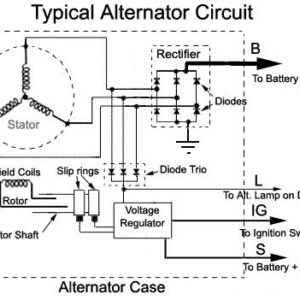
 2. Rotor (Rotating Part)
The rotor is the rotating part that produces the magnetic field.
Components of Rotor:
Field winding
Rotor core
Slip rings
Shaft
Functions:
Produces rotating magnetic field
Rotates using mechanical input
Induces voltage in stator winding
Alternator rotors are mainly classified into two types:
Large diameter
Short axial length
Poles project outward
Used in low speed machines
Suitable for hydroelectric plants
Features:
More number of poles
Used at low speed
Large size
Smooth cylindrical shape
Small diameter
Long axial length
Used in high speed machines
Suitable for steam turbine plants
Features:
Fewer poles
Used at high speed
Strong mechanical construction
Made of laminated silicon steel sheets
Slots are cut on inner surface
3-phase armature winding placed in slots
Windings are connected in star or delta
Rotor carries field winding
DC supply is given through slip rings and brushes
When DC flows through rotor winding → magnetic field is produced
Step-by-step working:
DC supply is given to rotor field winding
Rotor produces a magnetic field
Prime mover rotates the rotor (turbine/engine)
Rotating magnetic field cuts stator conductors
EMF is induced in stator winding
Output is obtained as AC voltage
Frequency of generated voltage:
f=P×N120f = \frac{P \times N}{120}
Where:
f = frequency (Hz)
P = number of poles
N = speed in RPM
Example:
If P = 4 and N = 1500 RPM
f=(4×1500)/120=50Hzf = (4 × 1500) / 120 = 50 Hz
Generated EMF per phase:
E=4.44×f×Φ×T×Kp×KdE = 4.44 × f × Φ × T × Kp × Kd
Where:
f = frequency
Φ = flux per pole
T = number of turns
Kp = pitch factor
Kd = distribution factor
Used in vehicles
Charges battery
Supplies power to lights and systems
Used in power stations
Large size
High voltage output
Used in small generators
For home backup supply
Excitation means supplying DC current to rotor field winding.
External DC source
Battery or DC generator used
No brushes or slip rings
More reliable
Used in modern alternators
High efficiency
Rugged construction
Less maintenance
Can generate large power
Better cooling system
Suitable for high voltage generation
Requires DC excitation
Synchronization required before connecting to grid
Complex control system
Higher initial cost
| Feature | Alternator | DC Generator |
|---|---|---|
| Output | AC | DC |
| Efficiency | Higher | Lower |
| Maintenance | Low | High |
| Commutator | Not used | Used |
| Brush wear | Less | More |
Due to resistance of windings
Hysteresis loss
Eddy current loss
Friction
Windage
Voltage regulation is the change in terminal voltage when load changes from no-load to full-load.
Voltage Regulation=Eno−load−Vfull−loadVfull−load×100\text{Voltage Regulation} = \frac{E_{no-load} – V_{full-load}}{V_{full-load}} × 100
Before connecting an alternator to grid, these conditions must match:
Same voltage
Same frequency
Same phase sequence
Same phase angle
Methods:
Lamp method
Synchroscope method
Thermal power plants
Hydro power plants
Nuclear plants
Wind turbines
Car charging system
Truck electrical system
Standby generators
Backup power systems
Wind energy systems
Micro hydro plants
In power plants:
Turbine rotates alternator rotor
Rotor produces magnetic field
Stator produces AC voltage
Voltage stepped up by transformer
Sent to transmission lines
Air cooling
Hydrogen cooling (large machines)
Water cooling
Large alternators use hydrogen because:
Better cooling
Low friction
Higher efficiency
Important maintenance points:
Check insulation resistance
Clean dust and moisture
Inspect bearings
Check brush condition
Monitor temperature
Tighten connections
Overheating
Low output voltage
Bearing failure
Field winding open
Insulation breakdown
Never run without load control
Proper grounding required
Avoid overloading
Check excitation system
Use protective relays