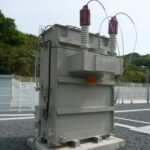



An electrical transformer is one of the most important and widely used devices in power systems and electrical engineering. From generation stations to transmission lines and finally to distribution networks that supply electricity to homes, industries, and commercial buildings, transformers play a crucial role in the efficient transfer of electrical energy. Without transformers, long-distance transmission of electrical power at high efficiency would not be possible.
A transformer is a static electrical device that transfers electrical energy from one alternating current (AC) circuit to another through the principle of electromagnetic induction, without any direct electrical connection between the circuits. It operates at the same frequency but usually changes the voltage and current levels. Depending on the requirement, a transformer may step up voltage, step down voltage, or provide electrical isolation.
This article provides a detailed and easy-to-understand explanation of Electrical Transformer: Construction, Working and Applications. The content is especially useful for ITI Electrician students, diploma students, engineering learners, and anyone interested in understanding the fundamentals of transformers.
An electrical transformer is a static device that transfers electrical energy from one AC circuit to another AC circuit at the same frequency but usually at different voltage levels, by electromagnetic induction.
In simple words, a transformer is used to increase or decrease AC voltage without changing the frequency.
The working principle of an electrical transformer is based on Faraday’s Law of Electromagnetic Induction. According to this law, whenever the magnetic flux linking a conductor or coil changes, an electromotive force (EMF) is induced in that conductor or coil.
In a transformer, when an alternating voltage is applied to the primary winding, it produces an alternating current. This alternating current creates an alternating magnetic flux in the magnetic core. The changing magnetic flux links with the secondary winding and induces an EMF in it. Thus, electrical energy is transferred from the primary winding to the secondary winding without direct electrical contact.
The construction of a transformer is simple and robust. The main parts of a transformer are:
Magnetic Core
Primary Winding
Secondary Winding
Insulation
Transformer Oil (in oil-filled transformers)
Tank and Cooling Arrangement
Each part has a specific function, which is explained below.
The construction of an electrical transformer mainly consists of two essential components:
Magnetic Core
Windings (Primary and Secondary)
Depending on the design, transformers may also include additional components such as oil tank, cooling system, conservator, breather, and bushings.
The magnetic core provides a low-reluctance path for the magnetic flux produced by the primary winding. It is usually made of laminated silicon steel sheets to reduce hysteresis loss and eddy current loss.
The laminations are insulated from each other by varnish or oxide coating. This insulation minimizes eddy currents and improves efficiency.
Types of transformer cores:
Core-type transformer
Shell-type transformer
The primary winding is the coil that is connected to the input AC supply. When voltage is applied to the primary winding, it draws current and produces magnetic flux in the core.
The secondary winding is the coil connected to the load. The changing magnetic flux induces an EMF in the secondary winding, which supplies power to the load.
The number of turns in the primary and secondary windings determines whether the transformer is step-up or step-down.
Proper insulation is essential to prevent short circuits between windings and between windings and core. Insulating materials such as paper, cotton, varnish, and oil are commonly used.
In oil-filled transformers, transformer oil is used for insulation and cooling. It helps to dissipate heat generated due to losses and also increases dielectric strength.
The transformer core and windings are placed inside a steel tank filled with oil. Cooling methods may include natural air cooling, oil natural air natural (ONAN), oil natural air forced (ONAF), and others.
Transformers can be classified based on different criteria:
Step-Up Transformer
Step-Down Transformer
Core-Type Transformer
Shell-Type Transformer
Single Phase Transformer
Three Phase Transformer
Power Transformer
Distribution Transformer
Instrument Transformer
The working of an electrical transformer can be explained step by step:
When an AC voltage is applied to the primary winding, an alternating current flows through it.
This alternating current produces an alternating magnetic flux in the transformer core.
The magnetic flux links both the primary and secondary windings.
Due to the changing flux, an EMF is induced in the secondary winding according to Faraday’s law.
When a load is connected to the secondary winding, current flows through the load and electrical power is delivered.
There is no direct electrical connection between primary and secondary windings; the power transfer takes place through the magnetic field.
The EMF induced in the windings of a transformer is given by:
E = 4.44 × f × N × Φm
Where:
E = RMS value of induced EMF (Volts)
f = Frequency (Hz)
N = Number of turns
Φm = Maximum flux (Weber)
The voltage ratio of a transformer is equal to the turns ratio:
V1 / V2 = N1 / N2
No transformer is 100% efficient. Some losses occur during operation, which are:
Copper loss occurs due to resistance of the windings and is proportional to the square of the load current.
Core loss consists of:
Hysteresis loss
Eddy current loss
These losses depend on voltage and frequency and remain almost constant.
The efficiency of a transformer is defined as the ratio of output power to input power.
Efficiency (η) = Output Power / Input Power
Transformers have very high efficiency, usually between 95% to 99%.
Maximum efficiency occurs when copper loss equals iron loss.
Cooling is necessary to remove heat produced due to losses. Common cooling methods include:
Air Natural (AN)
Oil Natural Air Natural (ONAN)
Oil Natural Air Forced (ONAF)
Oil Forced Air Forced (OFAF)
Electrical transformers are used in almost every part of the power system. Some important applications are:
At generating stations, step-up transformers are used to increase voltage for efficient transmission.
High-voltage transmission reduces current and minimizes power losses over long distances.
Distribution transformers step down voltage to safe levels for domestic and commercial use.
Transformers are used in welding machines, furnaces, rectifiers, and industrial power supplies.
Current transformers (CT) and potential transformers (PT) are used for measurement and protection.
Small transformers are used in chargers, adapters, inverters, and electronic circuits.
High efficiency
No moving parts
Low maintenance
Reliable operation
Long service life
Works only with AC supply
Heavy and bulky (for high ratings)
Oil leakage risk in oil-filled transformers
An electrical transformer is a vital component of modern power systems. It enables efficient generation, transmission, and distribution of electrical energy. Understanding the construction, working principle, and applications of transformers is essential for students and professionals in the electrical field.
Because of their high efficiency, reliability, and simple construction, transformers continue to be one of the most important devices in electrical engineering. Whether it is a small adapter or a large power transformer, the basic principle and operation remain the same.